Freight Factoring: What Every Carrier Should Know
This is a practical reference to carrier workflows, not financial or legal advice. Not all factoring contracts are created equal. Terms on recourse, minimum volume, termination clauses, reserve management, broker approval and other costs can all affect the bottom line.
Every carrier runs into a cash flow constraint at some point — waiting 30-60 days for a broker to pay while the gasoline, insurance and maintenance payments are due now. Freight factoring fixes the timing problem but the fees, contracts and fine print catch carriers who join up without knowing how it really works. Freight factoring is when you sell your outstanding invoices to a factoring company for immediate cash, usually 90-97% of the invoice. The remaining balance (less costs) is paid when the broker pays. This tutorial will explain how factoring works, how much it costs, when it makes sense, when self-billing is the better option, and how to make your invoices factoring-ready, no matter which option you pick.
How Does Freight Factoring Work?
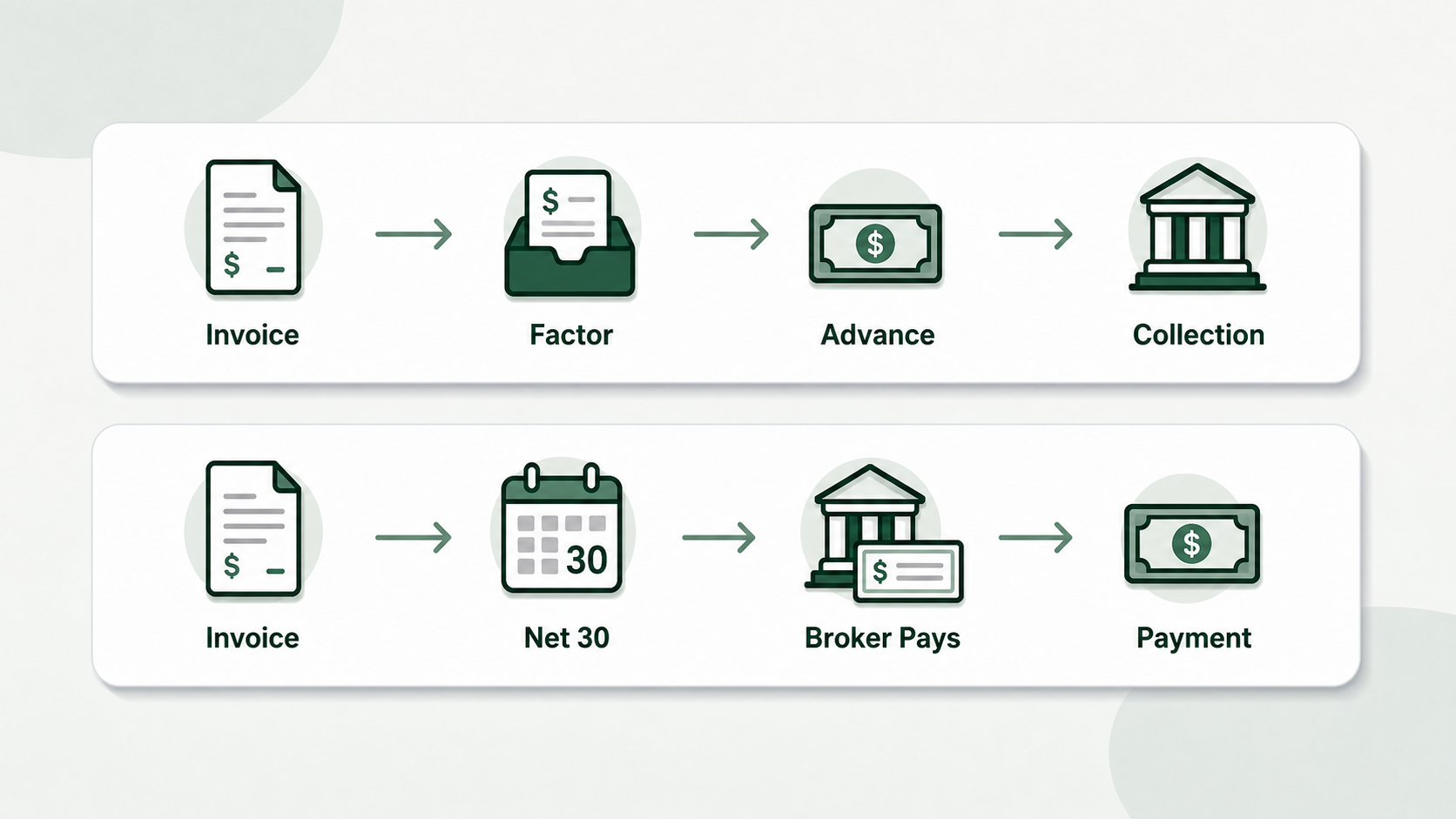
You deliver a completed invoice and signed Bill of Lading (BOL) to a factor. They check the broker’s credit, they advance you 90-97% of the invoice value (typically within 24 hours), and then they collect from the broker. Once the broker has paid you obtain the reserve less the factoring cost.
I calculated my invoices for the first 8 months after I got my authorization. The cash flow was a life saver, I couldn’t float 30 days of fuel costs on hope alone. Without factoring, I would have been out of operational cash by month three.
The method, step by step:
- Complete loading and obtain your paperwork (invoice + signed BOL)
- Send to the factoring company via their portal or email
- Credit check – the factoring company checks the broker’s credit (not yours)
- Prepayment – you get 90-97% of the invoice value, usually within 24 hours
- Collection — The factoring company gets the whole amount from the broker on usual Net conditions
- Reserve release — you get the remaining 3-10% minus the factoring fee once the broker has been paid
Example on $2,500 load at 95% advance and 3% fee:
- Day 1: You get $2,375 (95% advance)
- Day 30: Broker pays $2,500 to factoring company
- Day 31: You get $50 (5% remaining - $75 charge)
- Your total: $2,425 — you traded in $75 for instant cash
What Is The Cost Of Freight Factoring?
Typically, factoring fees range from 1.5% to 5% of each invoice, depending on your volume, the creditworthiness of your customers, and whether you opt for recourse or non-recourse factoring.
My first contract was 3.5% which was $70 on a $2,000 load. I was doing 15 loads a week and paying over $4200/month in factoring fees alone. It made sense when I needed the financial flow to survive, but after I built up reserves those fees started to feel like a tax on every load I hauled. Fee structures you’ll encounter:
| Fee Type | Range | How It Works |
|---|---|---|
| Flat rate | 1.5-5% per invoice | Same percentage regardless of how fast the broker pays |
| Tiered rate | 1-3% + additional per 10 days | Base rate for first 30 days, increases if broker pays late |
| Volume discount | 0.5-1% lower at higher volumes | Rate decreases as monthly invoice count increases |
Beware of additional charges:
- ACH/wire transfer fees — $1-$5 each wire transfer
- Invoice processing fees — $1-3 each invoice submitted
- Fuel advance fees — if you use the factoring company’s fuel card program
- Minimum monthly fees — if you don’t hit a minimum volume
- Early termination fees – if you quit before your contract is up
Recourse and non-recourse:
Recourse factoring (cheaper, 1.5-3%): If the broker doesn’t pay, you have to pay the factoring business back. You take the risk.
- Non-recourse factoring (more expensive, 3-5%): The factoring provider takes the hit if the broker doesn’t pay. They are taking the risk therefore they charge more.
Most factoring companies will offer recourse factoring as the default option. Non-recourse seems good on paper, but the higher charge means you’re paying for insurance on every invoice – even the ones you send to good brokers who pay you on time.
When is factoring a good idea for carriers?
When you are fresh (no cash reserves), scaling fast (adding trucks or drivers faster than receivables come in), or hauling for slow-paying brokers and can not afford the wait.
When I started factoring was important. I had authority, a truck, and insurance, but little working funds. The first several cargoes were Net 30, which meant that I had to pay a whole month’s worth of fuel, insurance and living expenses before I saw a single dollar in return. Bridging that gap was key which kept me on the road.
Good reasons to factor:
- New authorization, no reserves — You need funds to function while your initial invoices are still in Net 30 pipeline
- Scaling your fleet — When you add a second or third vehicle, there are additional upfront expenditures (fuel, insurance, driver pay) until the revenue matches up
- Slow paying brokers — Some brokers pay on Net 45 or Net 60. If that’s a big chunk of your loads, factoring smooths out the cash flow
- Seasonal cash flow gaps – If your load volume is not constant, factoring can help keep sluggish months from emptying your reserves
- No Debt – Factoring is not a debt. No debt to pay off, no interest building up, and your credit score doesn’t matter (the broker’s credit does)
When to consider factoring:
As you build up 2-3 months of operational expenses in reserves and your broker base continues to pay reliably within 30 days, you should ask yourself if you still require factoring. At this stage you are paying factoring costs on bills that would have been paid on time anyhow.
When does self-billing trump factoring?
If you can afford 30-day payment cycles with your cash flow, you’re running steady loads with dependable brokers and you’d rather retain that 1.5-5% each invoice in your pocket.
Once I had 3 months of operational expenses saved up I stopped factoring and kept the full invoice amount. The math was simple, 60 cargoes a month, average invoice of $2,200, 3% factoring rate, I was losing $3,960 a month in fees. $47,520 per year. That’s big cash for the sole owner-operator. The math at different volumes:
| Monthly Loads | Avg Invoice | Factoring Rate | Monthly Fee | Annual Cost |
|---|---|---|---|---|
| 20 | $2,000 | 3% | $1,200 | $14,400 |
| 40 | $2,200 | 3% | $2,640 | $31,680 |
| 60 | $2,200 | 3% | $3,960 | $47,520 |
| 80 | $2,500 | 2.5% | $5,000 | $60,000 |
Conversion from factoring to self-billing:
You don’t have to change overnight. Begin by self-billing your most trusted brokers (those who always pay Net 15 or Net 30 without any hassles) and then go on to factoring the others. As your cash reserves develop, start to migrate more brokers to self-billing. This hybrid method allows you to test the waters without risking a cash flow problem.
How to prepare your invoice factoring?
Factoring firms want a clean, complete invoice with matching load number, precise broker details, itemized costs and signed BOL attached. The sooner you submit, the sooner you’ll receive your advance.
My factoring firm declined my first three submissions since I didn’t have BOLs and had wrong load numbers. Same faults that would stall a broker’s direct payment – factoring doesn’t excuse shoddy invoicing. In fact it is less forgiving as the factoring company processes hundreds of submissions a day with tight validation standards.
What factoring businesses want:
- Load number match — the load number on your invoice must exactly match the load number on the rate confirmation
- Broker verification - broker must be on the factoring company’s approved list (credit checked)
- BOL existence and signature — receiver’s legible signature, linked to the submission
- Invoice accuracy – charges match rate confirmation, and there are no inexplicable line items
- No Duplicate Submission – you have not already submitted this load for factoring
How to speed up factoring submissions:
- Submit same day you deliver. Most factoring companies process same-day submissions for next-day advance
- Combine your invoice and BOL into one PDF – this decreases the chances of a missing-document rejection
- Use your own template all the time. AP clerks are speedier when they recognize your format.
- Double check load number before submission. One character off equals rejection and 24-48 hours delay.
Whatever you do, whether you factor or self-bill, the invoice quality criteria is the same: clean, complete and in line with the rate confirmation. A program that will auto-fill your invoice from the rate con and combine the BOL will ensure clean submissions every time no matter where you’re sending them.
CarrierInvoice pulls data from your rate confirmations, populates your template, and merges the BOL into a single billing package. Clean invoices are paid faster, whether it’s a factoring company or a broker’s AP department. Try it free with 10 scans.
Factor Smart, Not Forever
Factoring freight is a tool, not a permanent solution. It handles timing on cash flow, when you need it most – early in your career, scaling, or in slow periods. That’s 1.5-5% per invoice. It’s one of the most expensive tools you’ll utilize.
Know when to switch it on. Know when to take a hike. And whether you choose to factor or self-bill, invest in clear invoicing – because slow paperwork slows down payment, either way.
Automate the preparation of your invoices and send cleaner billing packages – factoring or direct. Get 10 free scans